


Table of Contents
Growing Up With the West
As a child of the 1950s and early ’60s, I was raised on Westerns — and I watched just about all of them.
From Wagon Train to Tales of Wells Fargo, the Old West was always there. I rode alongside Hopalong Cassidy and Roy Rogers and watched The Rifleman, Bat Masterson and The Life and Legend of Wyatt Earp.
One particular favorite was Broken Arrow.
The series ran in prime time on ABC for two seasons, from September 25, 1956, through June 24, 1958, with reruns continuing into 1960.
The main characters were Tom Jeffords, an Indian agent, and the Apache chief Cochise, played by Michael Ansara.
Broken Arrow was set in the 1870s and grew out of Elliott Arnold’s 1947 novel Blood Brother. The novel was made into the 1950 film Broken Arrow, starring James Stewart as Tom Jeffords and Jeff Chandler as Cochise.
What I remember most about the television series, though, was the relationship between Jeffords and Cochise. They were presented as equals who respected one another. At its heart, their friendship was about understanding and tolerance.
Looking back, I think that helped set the tone — along with my years in Indian Guides — for my lifelong fascination with stories of the American West.
Over the years, I’ve read both fiction and nonfiction about the Indian Wars, the Plains tribes, the gunfighters and other aspects of Western history.
And The Summer of 1876, which I recently finished, is one of the best.
The Summer of 1876: Outlaws, Lawmen and Legends
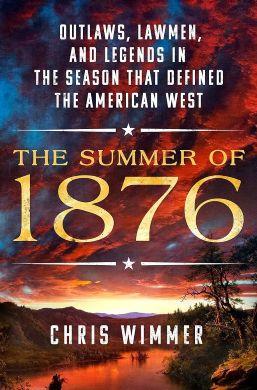
Chris Wimmer, creator of the Legends of the Old West podcast, uses The Summer of 1876: Outlaws, Lawmen and Legends in the Season That Defined the American West to weave together the events and people of one remarkable year.
And what a year it was.
At the center of the book is the Battle of the Little Bighorn. Wimmer provides one of the best descriptions of the battle that I have read — and I’ve read several accounts of Custer’s Last Stand.
But Custer is only part of the story.
Wimmer also brings us Wild Bill Hickok and Calamity Jane, along with Bat Masterson and Wyatt Earp. Rather than treating them as isolated legends, he places their stories alongside one another and shows what was happening across the West during that extraordinary year.
More Than Custer and the Gunfighters
Wimmer also tells the story of the James-Younger Gang and its disastrous attempt to rob the First National Bank in Northfield, Minnesota. Once again, it is one of the best retellings of the story that I’ve read.
But what makes the book especially interesting is that Wimmer doesn’t limit himself to gunfighters, outlaws and Indian wars.
The year 1876 marked the 100th anniversary of the signing of the Declaration of Independence. America celebrated its Centennial with an enormous exposition in Philadelphia.
It was also the first season of the National League.
And 1876 saw the publication of Mark Twain’s The Adventures of Tom Sawyer.
All of those threads help put the Western legends into a much larger picture of what America was becoming.
The Summer of 1876 Still Resonates
Maybe that’s what I enjoyed most about The Summer of 1876. Wimmer doesn’t simply recount a collection of famous Western stories. He brings them together and lets us see how many events that became part of American mythology were happening at almost exactly the same time.
Custer and Crazy Horse. Wild Bill Hickok and Calamity Jane. Wyatt Earp and Bat Masterson. Jesse James and Cole Younger.
One remarkable year.
So yes, the summer of 1876 was an incredible time — one that still resonates 150 years later.
Check it out!
Books About the Indian Wars From My History Shelves
Nonfiction
Son of the Morning Star — Evan S. Connell
Historical Fiction
The Long Winter Gone — Terry C. Johnston
Seize the Sky — Terry C. Johnston
Sioux Dawn — Terry C. Johnston
Red Cloud’s Revenge — Terry C. Johnston
Links
Creating an Indian Wars TBR Pile From My Own Books…..Join Me?
Final Thoughts — and a TBR Pile for Me. Join Me?
Writing about Broken Arrow, Cochise, and the Apache Wars reminded me of something else: I already have quite a few books waiting to take me beyond the television Westerns I grew up watching.
Over the years, I have amassed a huge Kindle library, thanks in no small part to BookBub, Amazon, Barnes & Noble, and my inability to pass up an interesting book at a bargain price.
Yes, I am both a Book Dragon and a Bookworm.
Some of the books below deal with Cochise and the Apache Wars. Others take me onto the Great Plains and the conflicts involving Crazy Horse, Sitting Bull, and Red Cloud. Still others go back to Andrew Jackson, the Cherokee Nation, and the forced removal of Native Americans from their homelands.
Since part of my 2026 Reading Challenge is to finally read more of the e-books gathering virtual dust on my Kindle, I think the time has come to move several of these toward the top of the TBR pile.
On My Kindle
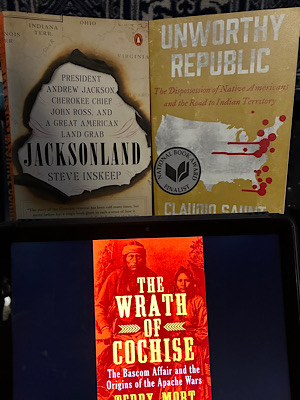
The Wrath of Cochise: The Bascom Affair and the Origins of the Apache Wars — Terry Mort
This may be the logical place for me to begin after writing about Broken Arrow. Mort tells the story of the 1861 confrontation between Cochise and Lt. George Bascom that helped ignite decades of warfare between the Chiricahua Apache and the United States.
The Apache Wars: The Hunt for Geronimo, the Apache Kid, and the Captive Boy Who Started the Longest War in American History — Paul Andrew Hutton
A much broader history of the long struggle between the Apaches and the United States in the Southwest.
The Heart of Everything That Is: The Untold Story of Red Cloud, An American Legend — Bob Drury and Tom Clavin
The story of Oglala Lakota leader Red Cloud and his successful war against the United States Army—a part of Western history that certainly wasn’t emphasized in most of those old television Westerns.
The Earth Is All That Lasts: Crazy Horse, Sitting Bull, and the Last Stand of the Great Sioux Nation — Mark Lee Gardner
A dual biography of Crazy Horse and Sitting Bull that follows the two Lakota leaders through the struggle that culminated at the Little Bighorn in 1876 and its tragic aftermath.
An American Betrayal: Cherokee Patriots and the Trail of Tears — Daniel Blake Smith
This one moves the story east and back in time, examining the Cherokee Nation, Andrew Jackson, John Ross, and the events leading to the Trail of Tears.
Stone Song: A Novel of the Life of Crazy Horse — Win Blevins
And a little historical fiction belongs on the list, too. Blevins’ novel tells the story of Crazy Horse and his world through fiction rather than conventional biography.
On the Bookshelf
And then there are two paperbacks waiting for me:
Jacksonland: President Andrew Jackson, Cherokee Chief John Ross, and a Great American Land Grab — Steve Inskeep
Inskeep tells the story through the intertwined lives of Andrew Jackson and Cherokee leader John Ross and the struggle over Cherokee lands.
Unworthy Republic: The Dispossession of Native Americans and the Road to Indian Territory — Claudio Saunt
Another look at Indian Removal, widening the story beyond a single tribe or individual and into the larger government policy that forced Native peoples westward.
So Where Do I Start?
That’s quite a reading list—and I already own every one of them.
I think The Wrath of Cochise may have just moved to the head of the line. After revisiting Broken Arrow and remembering Michael Ansara’s Cochise, it seems like the perfect opportunity to leave the Hollywood version behind for a while and learn more about the people and history behind it.
And after that?
Well, that’s the problem with being a Book Dragon. Finishing one book usually leads to three more.
Anyone want to read along?


